
Blog 2: How Women are “Supposed” to Look

A lot of women have an idea in their mind of how they are meant to look. Even if you don’t admit it, there have been times where you have compared your body to those of others and wished to look like that instead. Society sees beautiful as being, tall, skinny, having clear skin, nice hair and just overall looking “perfect” all the time. This is super unrealistic and toxic for women. This can lead to many women having eating disorders because they starve themselves and are malnourished in order to be skinny just all the models. “When young girls see these unhealthy messages, such as the need to have a thigh gap or flat stomach, it can increase their chance of developing eating disorder behaviors in order to obtain these body types.” (Gonzalez 2016). These beauty ideals often come from celebrities and models because these are the types of people that most men find beautiful. A lot of girls feel like they need to look pretty and perfect in order for a man to like them.  Magazines always use the pretty and skinny celebrities on their covers, and if they aren’t perfect enough the photos will get photoshopped to be more attractive. 

Not only are beauty standards about having the ideal body but it is also about race. Going into a makeup store or pharmacy, a white person will have no problem being able to pick out their right shade of foundation. Contrarily, if you are a person of colour and need a foundation, the selection is much smaller and the chances of finding a shade that is right for you becomes very slim. “The reason it is difficult to find beauty items for people of color is because the standards of beauty are discriminatory to anyone who isn’t white. Any face that represents anything relating to beauty is white, and if there is a person of color representing a certain beauty product they often are light skinned.” (Mattimore 2017) This may cause people of colour to not feel beautiful because they aren’t represented a lot on magazines and in fashion shows because the majority of the time the beautiful people that you see walking the catwalks are white. 

Something else that I found was interesting was beauty pageants. You hear stories all the time of young girls competing against each other to be the most beautiful contestant. This is really bad for girls to do because if they don’t win they might begin to question their beauty and wonder why they weren’t good enough to win. You shouldn’t be judged based on the way you look. Girls are put up on stage and are voted if they are pretty enough or not to stay in the competition.  It isn’t right that these young women are being pinned against each other based on what they look like. “ Countless people argue that they teach young girls that they have to aspire to arbitrary beauty standards.” (Mantai 2019) I believe that women shouldn’t be judged on how they look because it can lead to many problems that aren’t just insecurity. Health problems can develop due to feeling imperfect in their own body. What some people fail to understand is that everyone is built differently and just because someone looks a certain way doesn’t mean you have to. 

It isn’t right that women should feel like they have to be a certain way. What people fail to understand is that every individual is unique and that there are no two same people in the world. If all women looked the same, wouldn’t you agree that the world wouldn’t be an interesting place?

Works Cited

Gonzalez, Felicia. “Media Today : Unattainable Beauty Standards.” Girls Empowerment Network, Girls Empowerment Network, 27 July 2016, http://www.girlsempowermentnetwork.org/blog/media-today-unattainable-beauty-standards.

Mantai, Joshen MantaiJoshen. “Argument in the Office: Are Beauty Pageants Feminist or Flawed?” The Daily Nexus, 15 May 2019, dailynexus.com/2019-03-09/argument-in-the-office-are-beauty-pageants-feminist-or-flawed/.Mattimore, Dylan Megan. “The Problem With Beauty Standards.” Medium, Gender Theory, 25 May 2017, medium.com/gender-theory/the-problem-with-beauty-standards-5069f3e4569c.
Blog 2 – Society’s expectations of women

Historically, women have practically always been put under the power of their male counterparts and that, in every and any spheres of their lives. Whatever their social status, their ethnicity and their age, the role of caregiver has always been expected to be taken on by them and that, as well as the expectation of constantly being accommodating and submissive. As years have gone by, change has occurred, and women have been gaining in freedom and power, but some harmful gender norms have kept on strong and ultimately stayed embedded in our way of living.

When it comes to women’s appearance, it is still subject to restrictions, judgment and unattainable standards and has made more than one feel trapped in a box that did not match their inner-self (The Value of Women, n.d.). Defying the norm would lead one to be looked down upon and not to be appreciated at one’s fair value. This need for approval has recently generated a kind of fear within the population and, ultimately, has led to the arrival of a new beauty-based culture. With skincare routines, laborious regimes and cosmetic surgery evolving and taking over our society, the focus has been put on this rigid idea of ultimate beauty and has led to the creation of a race for who can exceed society’s expectations first. Its rules require one to be cautious not to be too manly or too feminine and to carefully balance every aspect of their looks – because God knows that only one false move, one crooked tooth, can create madness over which everyone will talk about and cause one to reach the bottom podium of the race.

As for society’s expectations of women’s behaviours, it is relatively similar. They are to act in ladylike manners and not to let their emotions take over their decisions – because it is known to all, of course, that women are predisposed to dramatic and irrational personalities. They are, instead, to take care of household chores and to please their husbands’ needs and wants at all times, because that’s what they do best. Everything is based on how one’s family, self and life looks, and not on how one feels. As mentioned before, luckily, those kinds of expectations have slowly died down over the years. Only, the world we live in still refers to those times and refuse to grasp the fundamental idea that women are equal to men and have the same cognitive abilities. Also, I am not stating, per se, that men have it easy compared to women when it comes to social standards, but women are to constantly run after this image of perfection, to carry it even through the roughest of times, all while fighting to get more of that freedom that men have. Yes, change has occurred through the years, but a lot is still to be made if we want, one day, for all to be considered as equals.

The Value of Women. (n.d.). Retrieved from https://www.usnews.com/news/the-report/articles/2017-12-05/study-women-valued-for-physical-attractiveness

Blog 2: Fashion and Feminism

     As early as I can remember, girls have been told what they should or shouldn’t wear. In elementary and even in high school we are told not to wear spaghetti straps because god forbid anybody finds out girls have shoulders. Fashion is often seen as something that is regressing the feminism movement when in reality it is having the opposite effect. Young boys and girls should not be taught that a woman’s worth can simply be determined by judging her based on what she is wearing. After all, we’re taught to never judge a book by its cover, whats the exception here?

     This past weekend as many of us know was the Super Bowl, more importantly the Halftime show featuring Shakira and Jennifer Lopez. Whilst most of us recognized their performance as amazing and most importantly, empowering some saw it as degrading. Why? Not because of their lyrics or the message they were telling the viewers but by their outfits. Instead of shaming these talented artists for their performance some people could only focus on what they were wearing. It’s quite ironic in more ways than one that people are criticizing both Shakira and Jennifer Lopez for their outfit choices when they were the same people who said nothing regarding Adam Levine’s halftime performance. In 2015, during the halftime show Adam Levine decided to tale off his shirt during his performance which no one seemed to have a problem with. Yet here we are, five years later and the double standard between the genders is more evident than ever. This year’s Super Bowl performance is seen as inappropriate and too revealing yet the 2015 performance was seen as unproblematic. A woman’s worth is not determined by her wardrobe and she should be able to freely express herself without others trying to diminish her success.

In the end, our choice of clothing is merely one of the many ways that we, as people decide to show who we are. Whether it be by wearing skirts or sweatshirts, the freedom of wearing what makes you comfortable should not be taken from you, as you are the only one who has control over that. This should be taught to all alongside the principle that both women and men should be praised for wearing what they see fit. Rather than being shamed for their own personal style as long as it does not harm anyone in anyway. Fashion may be the way we show to people who we are, but is should never be the judge of our worth.

References:

Agar, Jerry. (2020). AGAR: Was the halftime show objectification or empowerment?. Toronto Sun.

Blog 1: Feminism

When you hear the term “Feminism”, you will probably think that it is the urge and desire to gain rights for women. While that is true, it does not describe feminism in its entirety.For Valentini for example, feminism is something you define for yourself. It’s about finding the cause that works for you and makes you happy. For Hook, feminism is a movement to end sexism, sexist exploitation, and oppression. Even if those two definitions seem a little different, they both have the same objective: To create an equal world and to feel good about ourselves. Valentini’s definition was based more on doing what makes you happy and move on to dismiss someone and their opinions,meanwhile Hook’s was more based on the importance of male involvement in the equality movement, stating that for change to occur, men must do their part. Both of the authors are trying to make us understand how feminism isn’t about divisions but is a blueprint of a political movement for everybody.     

Although the two authors have a bit of two different definitions of feminism, after reading both articles I had understood that feminism is very important. Feminism not only allows you to see through the critics that would make you think there’s something wrong with you but also makes you feel good about yourself and to have self-respect. It is also important to them because it is what brings us together, it is where we stand. Feminism gives males and females the chance to be able to create a beloved community, to live together, to live in the truth, to live in a world that is “created equal”.     

  “Most young people are feminists, but we’re too afraid to say it —- or even recognize it. And why not ?“     

This had made me stop and think. After taking a couple of minutes thinking, I had realized that the author was right. Nowadays, most girls don’t always see sexism as a problem, they think it is just something they shouldn’t take too seriously and that is just a joke. Girls are less likely to call out boys for their sexist behavior. They do not want to appear bitchy or outspoken or unsexy. It would make them look like a feminist, and that for them it is too many implications: since you are most likely going to be considered that you were a prude, that you couldn’t take a joke, that you were a “man-hater” or a “bitch.”        

For me, feminism it’s equality for everyone. Let women have the same rights and be seen in the same way as men. All women, without exception, without barriers due to race or sexual and romantic preferences. Let there be no more injustices due to the gender of a person. It should go without saying, but it isn’t. Even if we evolve, we have not yet returned to this equality. We have to fight and defend our ideas until the end. For me, everyone can be a feminist and that’s a good thing, it shouldn’t have this false-negative connotation that I sometimes see spreading on social networks. We have to see it as a beautiful united movement. For me, feminism is knowing our history and being grateful for the struggle that has been waged and the best way to do it is to continue! Even though i always had my own opinion about feminism, these articles had helped me develop my meaning of it by seeing different definitions and opinions about feminism!      

Blog 2: “Take the B out of LBGT!”

It’s no surprise that the LGBT community faces stigmas, hate crimes and other general negative attitudes and comments. In Britain, hate crimes committed against LGBT people have increased by 78% since 2013. We all know there’s external hate, but do you know of the internal issues some members face? Bisexuals sometimes face discrimination as they’re “too straight” for the community, and yet, they’re “too gay” for heterosexuals. This hatred is so present that it’s been classified as a phobia. I found this quote on Wikipedia: “Biphobia is aversion toward bisexuality and toward bisexual people as a social group or as individuals. It can take the form of denial that bisexuality is a genuine sexual orientation, or of negative stereotypes about people who are bisexual (such as the beliefs that they are promiscuous or dishonest). People of any sexual orientation can experience or perpetuate biphobia.”

This deludes people into believing that bisexuality is not real or that a person is just on the cuffs of either being gay or straight and “should choose”. The phobia itself can stem from people believing that sexuality should be monosexuals, meaning either homosexual or heterosexual. Others might see bisexuality as an equal attraction towards men and women which is sometimes just not the case! In my instance, I lean very heavily towards women and yet I’m still bisexual, not a lesbian. I even had an ex who couldn’t wrap her head around the fact that I was bisexual (one of the reasons why she’s an ex). Now we know, homophobia is still persistent but people sometimes have problems seeing that a bigger issue persists within the community. “Biphobia is common from the heterosexual community, but is frequently exhibited by gay and lesbian people as well, usually with the notion that bisexuals are able to escape oppression from heterosexuals by conforming to social expectations of opposite-gender sex and romance. This leaves some that identify as bisexual to be perceived as “not enough of either” or “not real.”An Australian study conducted by Roffee and Waling in 2016 established that bisexual people faced microaggressions, bullying, and other anti-social behaviors from people within the lesbian and gay community.” (From the same Wikipedia page)

I feel that denying that this is an issue is more harmful, and I could even say deadlier than we think. I found an article from The Guardian that discusses this problem. “Research now shows how destructive shame can be. The Adverse Childhood Experience study led by Dr Vincent Felitti showed that the greater number of extreme negative experiences a child has, the greater the chance they will develop mental health problems in adulthood. The study showed the most damaging experience was not incest, as expected, but “recurrent chronic humiliation” – in other words, if you invalidate and criticise children over and over, you’ll dramatically increase the chance they’ll develop self-destructive mental health problems in adulthood.” I even read an interesting article written by Them that discusses the discrimination bisexuals can face coming from lesbians and gays. “Bisexual women, in particular, have it hard — at least when it comes to desirability within the LGBTQ+ community. Lesbian women and communities are notorious for rejecting bisexual women as potential friends and as sexual and romantic partners due to stereotypes that bisexual women are untrustworthy, unreliable, incapable of monogamy, disease carriers, and “sleeping with the enemy.” Bisexual men are also stigmatized by gay men to some extent, but given gay men’s lesser cultural emphasis on monogamy and greater interest in casual sex, bisexual men’s desirability is less affected by these stereotypes, and may even be bolstered by gay men’s preference for masculinity (which is perceived as higher among bisexual guys). This “double stigma” takes a toll on the wellbeing of bisexual people, with bisexual women in particular reporting more mood and anxiety disorders, substance use, and other mental and physical health issues compared to gay and lesbian folks.” Insane, right? How can a community that was created as a haven for every sexuality and gender that’s out of the norm now exclude its own members?

Manpreet Singh

References

Them. (2018) A New Study Explains Why Many Lesbians Are Biased Against Bisexual Women. Retrieved from https://www.them.us/story/study-explains-lesbian-bias-against- bisexual-women

Wikipedia. (2018) Biphobia. Retrieved from https://en.wikipedia.org/wiki/Biphobia

Stonewall. (2017) Hate crime against LGBT people in Britain increases by 78 per cent since 2013. https://www.stonewall.org.uk/news/hate-crime-against-lgbt-people- britain-increases-78-cent-2013

The Guardian (2018) Self-loathing among gay people is nothing new. We’re overwhelmed by it. Retreived from https://www.theguardian.com/commentisfree/2018/feb/08/self-loathing- gay-people-shame

Blog 2: The Dangers for Women in the Sex Industry

The subject of woman in the sex industry has always been a taboo. Whether they are forced or desperate, women are put in danger everyday by entering the world of sex industry. Sex workers are women at work — supporting children as single parents, trying to save money to go to school, surviving economically in a job market that underpays women at every economic level. As their acts are illegal, not regulated and not protected, they usually do not report the incidents they face and the culprits know that. The fact that they don’t puts the workers in even more danger. The victims of this vicious cycle have fallen in a series of traps set up by predators. Sex trafficking and prostitution are the two of the many problematics in the sex industry.

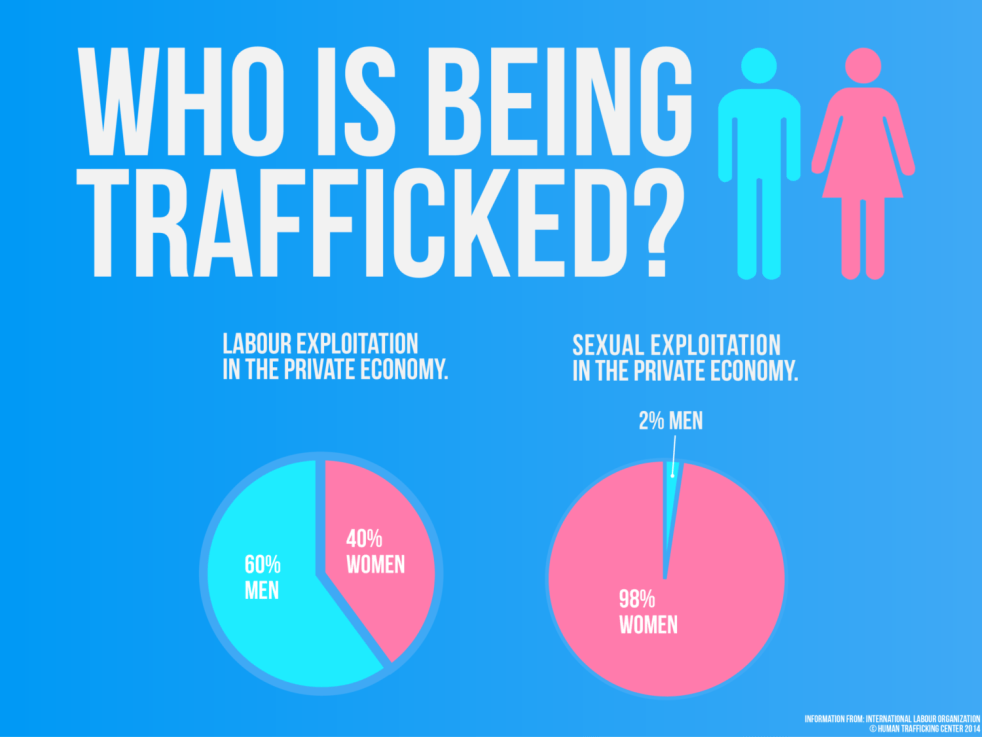
By definition, according to womenshealth.gov, human trafficking is a form of slavery. It happens when a person is forced or tricked into working in dangerous and illegal conditions or having sexual contact with others against their will. The victims are usually drugged, locked up, beaten, starved, or made to work for many hours a day. This form of modern day slavery generates an estimated $150 billion in annual profits. There are an estimated 40.3 million victims of human trafficking globally. Of those, 4.5 million are trapped and forced into sexual exploitation. This treatment takes an emotional and physical toll on the body. It also strips away all the woman’s basic human rights. We’ve seen many ruses, including children and hysteric teens, that have been used to lure and trap young victims. These tricks have been passed around the internet by influencers and Once taken away, victims do not see their families for years at times and go though severe physical trauma. It is extremely hard for victims to re-adapt to a normal routine when rescued.

Prostitution has become a gateway for human trafficking. Prostitution is the the practice of engaging in relatively indiscriminate sexual activity, in exchange for immediate payment in money or other valuables. Prostitution generates an estimated annual revenue of over $100 billion worldwide. It is a game changing factor in today’s economy. Many people have seen sex work as a business venture. In some states in the United States of America, brothels have been legalized to make prostitution safer. Multiple countries have adopted the practice of a “red light district” in order to profit from the sex trade. A red light district is a designated part of an urban area where a concentration of prostitution and sex-oriented businesses are found. Countries were pushed to create such spaces in light of research that has shown that many women have been killed and attacked by clients or their pimps. Many have been severely abused and raped but do not go report it in fear of getting arrested. Prostitution is now seen as an easy way to make money but it comes with a dangerous lifestyle. Moreover, girls are being tricked by pimps pretending to be their boyfriends. The predators first single out girls with low self esteem, then they spoil them and make them feel wanted. After they get attached to their “boyfriend”, he quickly removes his makes and puts in place his ruse to make her work for him under the pretext of “love”. There is a show on TVA called Fugueuse, which dives into the subject of prostitution and drug abuse.

Here’s a short documentary that explains risk of prostitution and the legalization of brothels: https://youtu.be/LRQqN0qPEus

Bibliography:

Blog 02: Street Safety for Women

It’s no secret, street harassment has been an ongoing issue for many women in Canada. The actions of catcalling, following and any unwanted physical behavior by strangers are serious forms of sexual harassment that everyone should be taking seriously. Some don’t take this issue seriously since it’s become culturally accepted, but I believe it’s crucial to speak up about it in order to end the harassment. Street Harassment, “can cause people to “choose” less convenient routes and alter their routines; give up hobbies and change habits; and even quit jobs or move neighborhoods or simply stay home because they can’t face the thought of one more day of harassment.” (kearl). Ultimately, it’s an issue that should require everyone to be greatly educated on. 

According to research concerning Canadian women who were affected by street harassment, “…over 80 percent of the women surveyed had experienced male stranger harassment in public and that those experiences had a large and detrimental impact on their perceived safety in public.” (Kearl). Ask anyone, I can guarantee you that almost every woman has experienced some sort of harassment or has felt unsafe at one point or another while walking on the street. It is ridiculous that majority of society thinks that it is okay to be making people feel uncomfortable while they are on the street. Regardless if someone gets hit on or whistled at, they are still valid examples of harassment and shouldn’t be tolerated. Due to all the issues happening on the street, society has agreed on some sort of stereotype where women can’t or shouldn’t be allowed to walk alone without being harassed by strangers. All this is doing is creating a fear for those who are being victimized and empowering those who are causing the harassment. Sadly enough, “It doesn’t just happen to adults: 70% of Canadian women experience this before they are 15, for some it happens before they are 10 years old.” (Fox). “Street harassment can happen to anyone too, Members of the LGBT+ community experience extremely high rates of harassment.” (Fox). Evidentially, feeling unsafe while walking on the street is something that happens to almost everyone and it needs to end.

 As a society it’s important to find ways to progress this issue, therefore, here are some ways of how society has helped progress and prevent this issue from recurring. Now available, “Anti-street harassment groups created by women who were fed up blossomed across the world”, “UN Women launched a Safe Cities and Safe Public Spaces programme in 2010”, “Several governments passed national or city-level laws on street harassment”, and “Anti-harassment and anti-violence organizations.” (Kearl). Obviously, there is no right way to deal with these types of situations, but having people just take initiative to start movements for street safety helps bring awareness. As for those causing the harassment, I believe that they need to take a step back realize that what they’re doing isn’t okay and how would they feel if the same thing was being done to them. The reason that I believe that it happens more than it should is because of confusion. Take for example, a man sees a pretty woman and he’s genuine about wanted to catch her attention, but the problem is the matter of how he chooses to catch her attention. Many things can make people feel uncomfortable and it’s crucial that we all learn about boundaries at one point. In my opinion teaching boys and girls at a young age of how to approach people is lacking and that’s why as a society, we are facing many cases of street harassment till this day. It’s just wrong.

References:

Fox, Naomi. “Street Harassment Isn’t a Compliment.” Canadian Women’s Foundation, 19 Dec. 2017, canadianwomen.org/blog/street-harassment-isn’t-a-compliment/.

Kearl, Holly. “Why Stopping Street Harassment Matters.” Stop Street Harassment, http://www.stopstreetharassment.org/about/what-is-street-harassment/why-stopping-street-harassment-matters/.

By: Julianna Noto

Blog 2: Imagine living in a Matriarchal society…

Well, if we want to know exactly what that would look like then we just need to read up on the history of First Nations communities that are actually the rightful inhabitants of the very land we stand on. The Kanien’Kehake nation once lived on and cultivated these lands, with thriving communities and efficient and culturally rich societies where women were expected to fulfill very important roles of power and responsibility. All women were revered and respected for their ability to create life, but they were also expected to make laws, choose male leaders and handle issues of property and agriculture (Freese-Maire). Families were matri-lineal and the women elders would command over their longhouses, filled with their daughters and grand daughters and great granddaughters families. Sons who found relationships would be expected to move into their partners long house and traditions and historical teachings were the clan mothers responsibility to maintain and share (Luger).

All of this came to a screeching halt, of course, once colonialism happened and the Western infectious patriarchy invaded and served major damage to so many innocent communities (Luger). Many First Nations creation stories include women being the ones responsible for the beginning of life, as compared to the many other religions who consider the main creator a man. Many of those same cultures also live within patriarchal societies (AJIC).

Historical reports show that within these matriarchal communities, the idea of family was first and foremost. The teachings of their traditions and the recounting of their stories were an essential part of their culture and community. The punishment of children was effective enough through the shame and disappointment of other family members and violence was never an option – in fact they would apparently just splash bad kids with water in an attempt to ‘wash the bad away’ (Haudenosaunee Confederacy). It was a peaceful and effective societal model that I would love to see rise again. If only…

Works Cited

Aboriginal Justice Implementation Commission. “Women in Traditional Aboriginal Society.” Aboriginal Women – AJIC.  http://www.ajic.mb.ca/volumel/chapter13.html#2 Accessed February, 2020. 

Freese-Maire, Roseanne. “Women in Iroquois History.” Iroquois Women – Womens History Blog.http://www.womenhistoryblog.com/2008/05/iroquois-women.html Accessed February, 2020

Haudenosaunee Confederacy. “Family Structure.” Culture & History – Haudenosaunee Confederacy. April 17, 2018. https://www.haudenosauneeconfederacy.com/historical-life-as-a-haudenosaunee/family-structure/ Accessed February, 2020.

Luger, Chelsea. “5 Indigenous Women Asserting the Modern Matriarchy.” Yes Magazine!, March 30,2018.https://www.yesmagazine.org/social-justice/2018/03/30/5-indigenous-women-asserting-the-modern-matriarchy/ Accessed February, 2020.

Blog 2: A Women’s Wardrobe

Briana Panaccione

Our style is a way of expressing ourselves. It is glimpse into who we are without verbally saying it. Our style is shown through the clothes we wear; it allows us to show our uniqueness, self confidence, and creativity. Our choice of clothes projects an image of who we are. Though it all sounds wonderful, here is the issue, some people will assume certain wrong messages by our choice of style and use it as an excuse to defend their actions or thoughts. For example, if a girl wears a short skirt and revealing top at a party, some people will assume that she is slutty and is asking for attention. But why can’t the message be that she is confident and feels sexy; and why does sexy have to be confused with being sexual? Or if a girl wears legging and a short top, people will assume she is trying to show off her ass or that she doesn’t have good morals etc. Why do clothes have to be sexualized and used as a justification for people’s thoughts. What we wear represents part of who we are, but it shouldn’t imply that we are promiscuous or asking for anything or have any other intentions then expressing ourselves.

There are many cases where women are criticized for what they wear when there are accusations of rape. There was a story in Jakarta where a man not only raped but also killed a girl. The capital governor blamed the girl for wearing a mini skirt instead of punishing the man’s awful actions. According to the site Mic.com, women protested in defensive saying: “Don’t Tell Us How to Dress, But Tell Them Not to Rape.” There are so many other cases where people blame rape cases on what the person wore, that we are “asking for it”, but I can bet that the majority of the world’s population wouldn’t ask to get raped or imply that in any way. We should have the social freedom to wear what we want and not constantly be judged or harassed. Rape or any form of assault should not be blamed for what the women was wearing. In article on Independent news, Dr Hannah Bows said ‘“We know that people are raped wearing a variety of clothing. The idea that a woman who goes out scantily clad will be pounced on is the most common myth across generations. They could be in their jeans, school uniform, or pyjamas.”’ She further explains that rape is not about what a woman wears but rather a man having domination and control over the women. It is time that people stop sexualising women’s clothing’s and realize who the true criminal is.

            It is scary and surprising that people of high authority such as police officers, judges, etc.…, would ever possibly accept or try to justify an action as cruel as rape or sexual assault. It is dehumanizing and disappointing that women have to worry about any consequences their outfits will sexually project to other people. Wardrobe and style are never and should never be an excuse for others committing degrading actions towards women.  

References

https://www.independent.co.uk/news/uk

https://www.mic.com/articles/141781

Valenti & Hooks

Valenti and Hooks, both feminist, have similar and divergent ideas on how to define feminism and what it means to them as individuals. When describing feminism, Valenti makes it feel like it is something for women, all women of course, but exclusive to females. Where as Hooks makes it more unisex, she defines feminism as something everybody can be as long as they stick with the basic idea that sexism, under any form, should end. The way these authors explain feminism is also quite different! Valenti takes the time to explain to her readers that the stereotypes on feminists are false and that they are a great factor why women are reluctant to publicly identify themselves as feminists. Hooks has a different approach, she explains where feminism in America comes from based on historic events including women as well as men from the white, native and black community. Putting aside their differences, these two very eloquent women agree that being feminist is something people should be proud of, and that the stereotypes given to the members of this movement are absolutely false and should not affect them. To them, feminism is important because it aims to end sexism, a concept that refrains, shames and oppresses women unjustly.

Based on my readings and summing up the definitions given by the two authors, I would say that a feminist is an individual that believes that there should be equality of sexes and an end to sexism. Even if it seems quite logical and simple, before reading these essays my definition of feminism was biased by the myths, rumors and stereotypes circulating in our society. To me,  a feminist was a radical woman, with very liberal ideas and a modern set of values fighting to be able to whatever she wants to do. I am glad to know now that being a feminist is for everybody and that there is no need for the members to stop wearing bras or stop shaving their armpits in order to be acknowledged as one, which was honestly a big relief, not that there’s anything wrong with people who choose to do so!

I was really pleased by the way Hooks explained feminism as it being a topic linked to racism and segregation. The reason why it paused my reading and made me enter into deep reflexion is because I always say “ I am not a feminist” with the idea in mind that before thinking of the equality of sexes, we should think of the racial equality. I was convinced of this without realising how closely linked these two concepts are and that we can really not separate them! Both movements seek to end unjust behaviours inflicted to them by other members of the society and in every ethnicity there are individuals of the two sexes. I guess my thought has always been that if a black, latina, asian, etc woman gets treated differently from others it is not principally because she is a woman but because she is a part of a cultural minority. And quite honestly, even if these readings opened my eyes into a new way to see the issue, I am still very confused.

After reading briefly about the two authors, I was happy curious to read their essays. I felt like these well informed women could teach me valuable things on the topics they addressed and I was not disappointed at all.