Blog 2: The Construction of Gender

Remember when we were in kindergarten having fun and playing with toys. The little girls would play with a baby doll or a kitchen set. On the other hand, the boys played together with their toy trucks and Lego. We can see that from a really small age we learned that men and women are separated. In other words, we learned it because gender is socially and culturally constructed. Everyone has their roles and different expectation according to their gender because of society. For instance, if a woman plays with a toy truck it would be seen as not right or she is “not girly enough”. The same thing goes for men. Why is it wrong for a boy to play with a toy doll? It was not our choice to assign different roles according to our gender. Our parents, family members, friends, religious beliefs and traditions are the ones who taught and constructed it in our minds (Macalo, 2019, para. 3).

In addition, there is a difference between gender and sex. Our sex is biological, it is what we are born with, but gender is what is the psychological, social or cultural (Adam, 2001, para. 5). This means a person can be whomever they want, but our gender is what is stopping us to do so. Many cultures around the world have their way of how they perceive gender. For example, the Mohave Natives of the United States of America have not only two genders, but four. They have male, female, alyha (male who lives as a woman) and hawme (female who lives as a man) (Blackwood, 1984, p. 28). In their culture, it is normal for a man to live as women and vice versa, but for the western culture is still a little hard to accept the peoples who are different from being men or woman. The idea of gender is passed down by generations and they become the norm. In our society, the LGBTQ people are struggling to settle or be seen as normal in society because we haven’t seen anything more than two basic genders.

Furthermore, social media has a big impact on our lives. Social media is a new tool to portray directly or indirectly those gendered ideas. In other words, with this tool, it has become easier to distribute and display views on gender, especially in western societies. For instance, in many of the superhero movies, we often see the men saving a hopeless and weak woman (2). Social media is in a way reinforcing the men and female qualities that are stereotypical (Wood, n.d, p. 232). The men are strong, providing, rational, active and protector. On the other hand, the women are weak, caring, emotional, passive and protected. Young children are highly influenced by social media and when they see these indirect, stereotypical and constructed characteristics they combine them into their reality. However, there has been a recent change in social media. More and more celebrities are coming out as part of being from the LGBTQ community. This is because we are breaking those socially constructed gendered ideas that are pass down to us from our childhood, but we still have a long way to go to fully socially deconstruct gender.

References

Adams, Alexia Jo. “The Social Construction of Gender.” The Social Construction of Gender – Applied Social Psychology, 3 Oct. 2001, www.personal.psu.edu/bfr3/blogs/applied_social_psychology/2011/10/the-social-construction-of-gender.html.  

Blackwood, Evelyn. “Sexuality and Gender in Certain Native American Tribes: The Case of Cross-Gender Females.” Signs, vol. 10, no. 1, 1984, pp. 27–42. JSTOR, http://www.jstor.org/stable/3174235. Accessed 7 Feb. 2020. 

Macolo, Micheal. “Time to Move Beyond ‘Gender Is Socially Constructed.’” Psychology Today, Sussex Publishers, 31 July 2019, http://www.psychologytoday.com/ca/blog/old-school-parenting-modern-day-families/201907/time-move-beyond-gender-is-socially-constructed. 

Wood, Julia T. “Gendered Media: The Influence of Media on Views of Gender.” Department of Communication, University of North Carolina at Chapel, pp. 231–244. 

Written by Hassan Waheed

Blog #2: Sexuality and Asian Culture

My topic of research is sexuality in the asian culture, more precisely: homosexuality in China.

“Ancien China had a rich literature of strong male homosocial culture” (Louie,
2002) Indeed, people were acceptant towards men with a preference for other men. This is because masculinity was considered more as a “social obligation”. Therefore, as long as the man fulfill his duties, which were to get married to a woman and to have children in order to carry on the bloodline, people overlooked men’s sexuality. As Travis S. K. Kong states in his work The sexual in Chinese sociology: homosexuality studies in contemporary china: “In other words, masculinity was understood less as sexual identity or orientation and more as a familial and social role […]” Homosexuality was then seen as a “side hobby”. In the early 20th century, many Chinese intellectuals brought Western ideology into China, agreeing more with it than traditional Chinese schools of thought. Sexuality was still seen as a disease and few was interested in this topic, but more and more intellectuals started to study Western studies and tried to understand why some people are attracted towards people of the same sex. The surge of interest towards sexuality created many debate about this topic; the population tried to categorize homosexuality into right or wrong, socially acceptable or taboo and if homosexuals could be cured from it (it was seen as a disease, therefore was maybe possible to cure it).

Ok, after the brief overview on the history of homosexuality in china, I want to talk more about the stigma gay men often experience in China and its consequences. In the conservative China, people are often pressured to get married and to have children by their parents and relatives. According to Bill Powell’s CHINA’S BIG CLOSET, “That pressure is only intensified by the country’s controversial one-child policy, in place since 1979.” The pressure makes gay men and women in China hide their sexuality, since being a homosexual is still considered as shameful and is contrary to what the elders’ expectation. According to the China’s LGBT Community Survey by Community and Marketing Insights, there is “only 3 percent of gay men are ‘completely out.'” This research shows how hard it is for people to come out in China. Another example I found to illustrate how gay men is treated is the case of Xiao Jun, a 30 year old gay man. His mother called him after having suspicions about him being gay and after Jun told her about his preference for men, she hung up on him. Fearing being laughed by their relatives, his parents then let them to introduce women to him and said to him that his homosexuality was a disease and that it was “curable”. What surprized (or didn’t) me was that most stigma that homosexual people face in China come directly from their family. An interview with Chinese MSM (men who have sex with other men) from Charting a Moral Life: The Influence of Stigma and Filial Duties on Marital Decisions among Chinese Men who Have Sex with Men illustartes the inequity these people face:

“Interviewer: Where would discrimination occur?
Participant: Well, for example…family members. Of course I think that in the end, family is tolerant. But despite that, it [knowing a person is MSM] would change how they perceive you. Let’s say there were some coworkers or neighbors that I wasn’t especially close with. If they found out my identity, I think they would look at me as if I were a freak. –Participant 21 (37 years old, college education, originally
from Beijing, currently unmarried)”

Indeed, the pressure for homosexual people to get married and to have children mostly comes from parents and relatives, and it makes harder for them to come out since they know that tradition is important and they don’t want their parents to be worried by the fact that they would grow old alone or to embarass their parents in front of aquantance and relatives. Homosexual men are often torn beween their own happiness or to live according to their parents’ wish and to be a good son. Some men chose to sacrifice their private life and to get married to a woman in order to appear “normal”, but other men refuses to conform to those norms and traditions:

“My viewpoint is very extreme in terms of marriage between MSM and heterosexuals. I resolutely condemn it, do you understand? […] There are people who say it’s in order to protect oneself because of the so-called environment, so they have to get married to a woman. This I resolutely condemn, I object to these kinds of things. I feel that it’s not ethical. […] To sacrifice a woman in exchange for oneself, to protect oneself, I feel like this is an extremely unethical thing. –Participant 9 (52 years old, college education, originally from Beijing, currently unmarried)”

I do agree with this man’s point of view and I also do think that it is unfair for both parties in this kind of marriage, since the man would never love his wife the way he loves another man. In my opinion, all parties is on the loosing side: the man is married to someone he cannot love, and the parents are living in a lie, thinking that their child have found happiness.

To finish, I would like to state that what I wrote is the result from my reasearches and it is not a criticism about China or the Chinese culture or its people.

Sources:

Kong, Travis S. K. “The sexual in Chinese sociology: homosexuality studies in contemporary china.” Sociological Review, vol. 64, no. 3, August 2016, p.495-514. EBSCO, http://proxy4.vaniercollege.qc.ca:2079/ehost/detail/detail?vid=4&sid=605e2a8a-e4e8-4111-bafd-0e8a91ec890f%40pdc-v-sessmgr02&bdata=JnNpdGU9ZWhvc3QtbGl2ZQ%3d%3d#AN=117510900&db=aph

Powell, Bill. “CHINA’S BIG CLOSET.” Newsweek Global, vol. 163, no. 12, September 24 2014, p.18-20. EBSCO, http://proxy4.vaniercollege.qc.ca:2079/ehost/detail/detail?vid=4&sid=c7ecc3db-1013-46d7-a012-ffcc72b8e91d%40pdc-v-sessmgr02&bdata=JnNpdGU9ZWhvc3QtbGl2ZQ%3d%3d#AN=98286777&db=aph

Steward, Wayne T. “Charting a Moral Life: The Influence of Stigma and Filial Duties on Marital Decisions among Chinese Men who Have Sex with Men.” PLoS ONE, vol. 8, no. 8, August 2013, p.1-9. EBSCO, http://proxy4.vaniercollege.qc.ca:2068/ehost/detail/detail?vid=4&sid=b29b7257-ebb2-403e-a1e5-30bd9201ff60%40sessionmgr4008&bdata=JnNpdGU9ZWhvc3QtbGl2ZQ%3d%3d#AN=90071776&db=aph


Slut Shaming

Misogyny, sexism and hatred toward women have always been present in society. Anti-Feminism has existed since modern times. Men who practiced Christianity were against women’s independence, moreover they were against the right for women to vote, work, make their own decisions and to be equal to men. In addition, male saw their wives as sexual objects which is why most of them forced their wives to have sexual relations with them in order to have kids. Since then, many stereotypes have been made toward women such as women that dress in a certain way are sluts, women that engage in sex are also sluts, and etc. There a huge sexual double standards between men and women. Let’s take the example of Kim Kardashian, when Kim posts a picture of her body on Instagram she gets called a “Slut, Whore, Attention seeker”, but if a male celebrity like for example Justin Bieber posts a shirtless picture, no one says anything, people do not seems to care about it. It’s the same case when a man cheats on his girlfriend people refers him as a “Playboy”, but if it’s a woman she is referred as a “Slut”.

The word “Slut” have been used for year against women. Slut Shaming consists of bullying a woman for her sexual practices or dress style. This concepts justify rape. In fact, many misogynists justified their actions by saying that some women deserve to get raped because of how they dress and they refer them as “attention seeker”. (Boaz 2016) Slut Shaming can take various forms. Bullies often use websites to post explicit photos of a woman, Many times, these photos and videos are taken without the target’s knowledge. Some boys have also been known to record their sexual activity with a girl and they then share it on the web. Many boys have also slut shamed girls by exposing the nudes of a woman without her consent. Slut shaming can impact someone’s life in a really bad way. Many girls committed suicide because of the bullying they received by their classmates. (Gordon 2019)

Amanda Todd killed herself on October 10, 2012. It all started with her having a conversation with a guy she met online. The man took pictures of her breasts and posted it on social medias. Since that happened, Amanda received a lot of hate and insults, she was being called a : “Slut, Whore, Prostitute, and etc.”. Due to this bullying, Amanda committed suicide. (Dean 2012) A lot of victims that experienced slut shaming spoke about their experience. Samantha confessed that she was slut-shamed back in high school and it ruined her life, she was getting anxious and didn’t want to step a foot outside of her house. Jennifer also said that she used to be slut-shamed by her ex husband and she was worried when he was drunk because he had anger management issues. (Laderer 2017)

In conclusion, slut shaming is a big issue in the world of feminism. There is a lot of sexual double standards between male and female. Slut Shaming can ruin someone’s life and I think we should educate people on how bad it is and the impacts of it.

Bibliography:

Boaz, B. (2016). Dangers of Slut-Shaming. Retrieved from https://rampages.us/univ200ramblings/2016/05/02/dangers-of-slut-shaming-multimodal-essay/

Dean, M. (2012). The Story of Amanda Todd. Retrieved from https://www.newyorker.com/culture/culture-desk/the-story-of-amanda-todd

Gordon, S. (2019). The Effects of Slut-Shaming on Teen Girls. Retrieved from https://www.verywellfamily.com/the-effects-of-slut-shaming-on-teen-girls-460586

Laderer, A. (2017). Women share slut shaming stories- and admit why they do it on themselves. Retrieved from https://www.talkspace.com/blog/women-share-slut-shaming-stories-admit/

Blog 1 : Defining Feminism

In my opinion , I think for both of them it is necessary to promote feminist because many people think one way towards feminists .They all have that same perception that feminists are ugly and about hating men .For Jessica Valenti, she finds that we should not have one vision towards feminists . She focuses more on  equality towards both genders . For Bell , she defines feminism as being a movement to end sexist oppression. She basically is explaining that we should end stereotypes towards women . Both authors have the same perception towards feminism but their definitions are a bit different .

Their definitions is similar because they believe that people have their own definition of feminist .They explain how the world sees feminism as being anti-men, hairy ugly girls .Hook’s shows how some people see feminism being an ideology for protest only . For these two authors , feminist is important because it is something they believe in and want people all around the world to promote it and stop seeing it as a a atrocious ideology towards men.

 I would describe a feminist as being someone who stands for the rights of both genders .Someone that has an ideology of what being a women is and how it is important to be equal to the opposite sex . Although , now that I read what the two authors have to say about feminist , I know more and I know it is not only about the  equality of both genders .

In the text of Valenti , she says how “all women are feminist  by the virtue of having ovaries” It really made me think because it’s true.Us women,have it much harder for men ,everything we do that isn’t seem as “appropriate “ for example not shaving your body can be considered dirty for a lady.As for men, it is totally normal if they grow hair on their bodies .It made me think because girls are always more judged compared to boys.

I did some research on both authors , and I was really interested by Bell Hooks . She is a black feminist that studied African-American Studies which examined the varied perceptions of black women who are writers and their development of feminist identities . I found that very interesting that she studies women in her culture . Being a black women is already hard , and I love the fact that she embraces it.

By Alexia Ighekpe

Blog 2: Women, sports and money

  Professional sports is one of the biggest industries in the modern society, a lot of money is invested, and modern athletes earn serious amounts of money. Most of the mainstream sport leagues have enormous budgets, but this money isn’t always fairly distributed between genders. For example, the average salary in the WNBA is around 75000$ and the maximum goes to 115000$. It can sound like a normal revenue, but the average NBA player makes 6,388,007$ per year and it goes as high as 37.5M$. We can definitely see that there is a huge wage gap. This huge disproportion is present is most of the professional sports leagues.

  The first question that comes to mind is why male make so much money compared to female. The answers can vary, but I think that the main reason is the coverage and the publicity the different sports get. For example, the leagues like the NBA or the NHL make a lot of publicity and this publicity creates a bigger fan base and more money. It’s very different for women sports. When did you see a WNBA commercial? The fact that the male leagues have more publicity then the female leagues makes a huge difference. Another interesting thing is the fact that some people say that male leagues are more entertaining, but I think that they are not right. In fact, women hockey and gymnastics are some of the most watched events at the Olympics. This proves that women’s sports are not less interesting, but professional women athletes make so much less money then male athletes.

  There is always a solution to a problem. The International Swimming League (ISL) proved it. This professional swimming leagues gives equal winning bonuses to men and women, also both genders make the same amount of points during the season and both genders get the same public attention and contracts. It’s the first professional league to give equal revenues and budgets to both men and women athletes. Even the MVP of the league is chosen between men and women, and the 2019 MVP was a Sarah Sjostrom, a fantastic women athlete!

Sources:

https://www.businessinsider.com/nba-highest-paid-players-2018-10

Top WNBA Salaries vs. NBA Salaries [2018 Update]

https://en.wikipedia.org/wiki/International_Swimming_League

https://fr.wikipedia.org/wiki/Liste_des_plus_gros_contrats_sportifs

https://bleacherreport.com/articles/2656664-ranking-the-top-ten-olympic-sports-to-watch#slide9

Blog 2: Women’s Place in Italy

This past summer, I took the most memorable trip of my life. I had the opportunity to go visit the village where my grandfather grew up during his childhood. He spent most of his life in a small town named Falascoso in Abbruzzo. During my stay, I attended a festival where I watched a play about women abuse in the South of Italy. Therefore, I will be writing a blog about women abuse in Italy and how the female gender is perceived in the Northern part of Italy compared to the Southern part. I would like to educate others and myself on this situation and bring awareness to everyone on the gender inequality that is still occurring around in Italy and around the world.

To begin, feminism has not reached Italy as it has in North America and gender discrimination is still at a high rate around the country. Statistics show that at least 6,788,000 women in Italy were victims of physical or sexual violence in 2015 and roughly 150 women a year are killed in Italy by abusive partners. (Pianigiani 2018) These two statistics are very close to the highest rates in all of Europe.  This is a big problem for women because they have minimal power and are afraid of standing up to something that has been seen as normal for decades. Also, they do not have enough power to make differences, for example, statistics show that only 14% of mayors in Italy are women and they are mainly in very small communities. (Boyarkina 2017)

There is a strong presence of inequality between both genders and discrimination in the labor force is still present in Italy. The Italian community is very traditional in their mentality and culture, historically as in other countries, women played a secondary role in society. They still believe that women should stay home and be a housewife instead of going into the labor force. This leads to women becoming very dependent on their husbands in every aspect of their life, such as, economically, socially, etc. They tend to rely on the income of their husband to keep themselves fed and sheltered. This creates a problem because the women tend to remain silent when they are physically, psychologically or sexually abused. (Boyarkina 2017) They have nowhere to go and no money to support themselves if they were to leave their husband. Also, Lella Paladino, president of Di.Re., a nationwide advocacy group that fights violence against women, stated, “When a woman tells her story, authorities rarely believe her, so in the end women stop speaking up,” (Pianigiani 2018) Therefore, women do not speak of their problems and suffer in silence which creates major depression and anxiety. The women who do speak up and try to escape are often fighting for years in Italy’s Byzantine legal system while their partners often threaten to sue them for defamation, stalk them or continue to abuse them. Women can wait up to two years to see their cases discussed in court, living in a constant fight with their exes. These cases can extend up to 10 years. (Pianigiani 2018)

To continue, statistics have shown major differences between the violence against women in the Northern part of Italy compared to the Southern part. The North of Italy has always been a richer and more prosperous region of the country. Its inhabitants tend to be more highly educated and many different industries have settled in that part of the country. These factors have decreased the old mentality in this region of Italy. However, statistics have proven that women abuse is much higher in the Southern parts of Italy where the economy and living conditions are not as evolved. In the North, women take up 50% of the labor force, however in the South, there are only 33% of women in the labor force. (Boyarkina 2017) To conclude, there have been improvements in women’s rights in the last few decades in Italy, however there is still much to do in bringing the woman’s situation to the level it deserves to be at.

Bibliography

Boyarkina, Iren. Violence Against Women In Italy. 2017. https://www.processjmus.org/violence-against-women-in-italy-a

Pianigiani, Gaia. For Italy’s Abused Women, a Legal Labyrinth Compounds the Wounds. 2018. https://www.nytimes.com/2018/08/11/world/europe/italy-abused-women.html

Blog 2: Women and Sports

When we think of sports, we think about exercising our body, dripping with sweat, becoming an image that would be associated with the country we support, and we think about having fun. Sports are for everyone yet; boys are more engaged in playing sports. Is it because we believe that females are inferior to males when it comes to physical activities or is it because of gender polarization and the number of opportunities they have been given?

According to WSF Teen Sport Report, 2018, 40 percent of teen girls do not actively participate in sports. This can also be directly linked to the 1.13 million opportunities given to boys instead of girls according to the National Federation of State High School Associations 2018-2019. Society does not approach girls as much as they approach boys. This causes young girls to categorize sports as an activity created for men and separate themselves from it.

Due to society labelling sports as an activity created for men, women have been treated as inferior beings, as they have rarely made more revenue than men when they have been displayed on the screen. This also has an impact on the final cash prize. For example, FIFA’s total prize money was around 400 million dollars for the men’s team in contrast to the 30 million for the women’s team in 2018. This is not the only case in which women’s sports teams have faced inequalities and will certainly not be the last one.

Sources:
https://en.wikipedia.org/wiki/Gender_polarization
https://www.womenssportsfoundation.org/what-we-do/wsf-research/
https://www.uplifterinc.com/gender-inequality-in-sports-how-to-grow-female-sports-audiences
https://www.wsj.com/articles/u-s-soccer-says-womens-team-has-been-paid-more-than-mens-team-11564440487

Blog #2: Women and Modern Slavery

One of the largest criminal industries is human trafficking and it is growing insanely fast, mostly in the US. It is another form of slavery, called “modern slavery”. (Tharanga Yakupitiyage, 2019) Men and boys are victims of labor and commercial sex trafficking, but not as much as girls and women. Women are manipulated, lured from the traffickers, which leads to female victims being controlled in a vulnerable state. A female is vulnerable when she is unprotected, in other words when she has no connection to social or family support. Immigrants, refugees and those with disabilities or trauma are the first targets traffickers seek.(American Psychological Association, 2014)

There are many types of human trafficking: sexual exploitation, labour exploitation, domestic servitude, forced marriage, forced criminality, child soldiers and organ harvesting.(Subzero & Heweet Mike, 2020) When I looked up all of these types of human trafficking that take place in our every day to day life, I only saw reports, articles that talk about women within that type of trafficking. Women are the main targets, and for once they are prioritized over men. In sexual exploitation women go into prostitution, pole/lap dancing, sex tourism, forced marriage and many more. Labour exploitation has women working in the agriculture field, manufacturing, hospitality, fishing and more, in which they are not payed enough, violated, punished and threatened to be exposed to immigrant authorities. As for domestic servitude, women are forced to work for long hours in the house, with which ties the forced marriage. Forced criminality is self explanatory, women are forced to do drug, cannabis and other illegal trades, as well as bad snatching, pick-pocketing, etc. Finally, organ harvesting is when traffickers kidnap an individual and without consent remove their organs in order to sell it. (Subzero & Heweet Mike, 2020)

Human trafficking is a topic that is unspoken and females are the main victims and targets. It is a world wide problem, 20 to 40 million people are in modern slavery, of which 71% are females. Thanks to online social media, it is growing. (Anonymous) Feminists want “protection from domestic violence, sexual harassment, and rape” and human trafficking does not provide any of those. (Humanities Ohio, 2018)

References:

Tharanga, Yakupitiyage. “Fighting the World’s Largest Criminal Industry: Modern Slavery.” Inter Press Service. January 2019. https://www.google.ca/amp/www.ipsnews.net/2019/03/fighting-the-worlds-largest-criminal-industry-modern-slavery/amp/

American Psychological Association, Task Force on Trafficking of Women and Girls. (2014). Report of the Task Force on Trafficking of Women and Girls. Washington, D.C.: American Psychological Association. https://www.apa.org/advocacy/interpersonal-violence/trafficking-women-girls

Subzero & Heweet, Mike. “Types of Exploitation.” STOP THE TRAFFIK. 2020. https://www.stopthetraffik.org/about-human-trafficking/types-of-exploitation/

Anonymous. “11 Facts About Human Trafficking.” Do Something.org. https://www.dosomething.org/us/facts/11-facts-about-human-trafficking

Humanities, Ohio. “Betty Friedan: The Three Waves of Feminism.” OH Blogs and News. April, 2018. http://www.ohiohumanities.org/betty-friedan-the-three-waves-of-feminism/

Blog 2: The portrayal of women

Wherever we look, we are bombarded with images of female bodies, women and girls – and their attributes – used to sell anything, from food to cars.

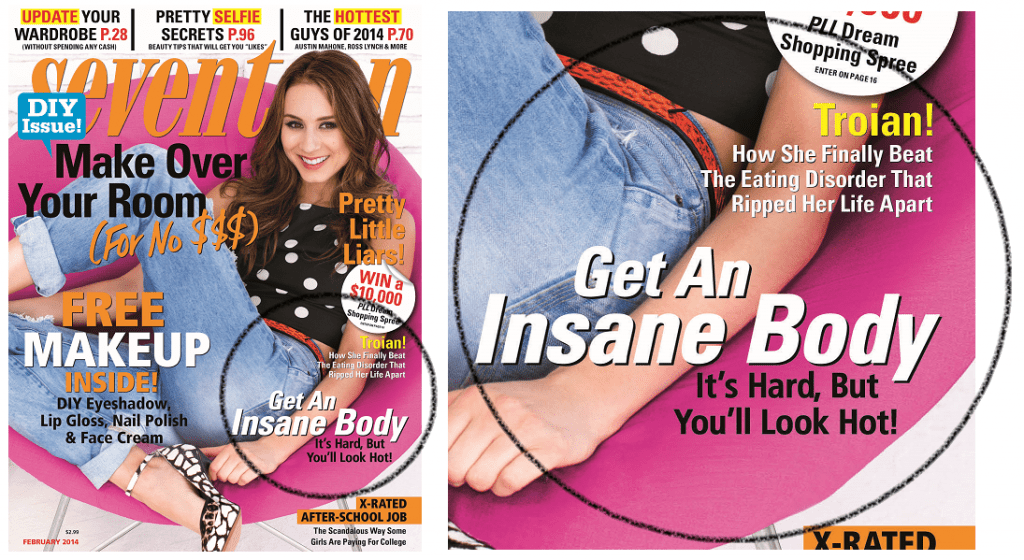
We could see how in our society, film and television actresses are getting younger, taller and slimmer. Women’s magazines are full of articles highlighting the urgency of losing those extra 10 pounds to finally reach happiness . Besides, did you realize how almost all of the models have the same type of hair and makeup?
How can we impose unattainable beauty criteria on young girls when the majority of them are nothing like the models we offer them? By presenting an ideal that is difficult to achieve and maintain, we ensure growth and the profitability of the slimming and cosmetic industry. (It is estimated that the slimming industry alone generates $ 60 billion (US) each year by selling sporadic slimming treatments , as a result of which 80% of people regain the pounds lost during this diet). Advertisers know that if girls and women are dissatisfied with their looks, they are more likely to buy cosmetics, new clothes, and diet products – so a huge media industry has been built by feeding, quite simply, this dissatisfaction that eats away at most women.

Overexposure to these images affects girls by pushing them to buy beauty products and slimming diets, but the consequences of this situation are even more serious. Research shows that when girls and women are constantly exposed to these images of young, slender, smooth-skinned women, they risk developing depression, low self-esteem, and poor eating habits: one of these studies show that half of girls between the ages of 16 and 21 say they want to have surgery to improve their appearance and almost half of girls aged 9 to 12 say they want to be thinner and have already followed a diet or know the principle of it . Poor self-image can have serious consequences, research published in 2009 reveals that girls who are dissatisfied with their figure are far more likely to attempt suicide – whether or not they are overweight

The consequences are serious and very real.Young girls must therefore be helped to acquire a critical mind but also to understand how a media representation of the female body is constructed and why these images make the headlines. Even better, they must acquire the strength to challenge these media images and demand a realistic representation of the female body. As young girls are exposed to these messages from an early age, we need to start media literacy much earlier, from an early age.

References: 

 The U.S. Weight Loss & Diet Control Market. Marketdata, survey May 2011.
 
Clark, L. & Tiggemann, M., 2006. Appearance culture in nine- to 12-year-old girls: media and peer influences on body dissatisfaction. Social Development, 15(4), 628-643. 
[6] Girl Guiding UK. Girls Attitude Survey. 2009. 

 Overweight status, self-perception, and suicidal behaviors among adolescents. Dhaval Dave and Inas Rashad. Soc Sci Med 68(9):1685-91 (2009) PMID 19297063) 

Blog 2: Stereotypes of feminism

To start the topic of stereotypes of feminism, we must take into account the actual definition of feminism; feminism is wanting political, economic along with social equality between men and woman. With that being said many men and women still don’t identify themselves as being a feminist as there are many stereotypes attached to that term. This is to show that many don’t truly grasp the true concept and definition of what being a feminist really is(“Myths about Feminism”).

There are many known stereotypes that can be attached to the term feminism, for example the most known one is women that hate men. This becomes a type of barrier that prevents men and women from wanting to be a feminist, as they say that it isn’t right to hate men. Although the previous statement is false, many people still believe that considering yourself a feminist it means that you hate men and you believe women are better than men. Also along with the misconception of the term, people believe that feminist can only be women, hence by the name, yet that isn’t the case as well. With those being the top two stereotypes that most people have on the topic of feminism, there are still many more stereotypes to add to the list which people still believe is the true definition of feminism(“Myths about Feminism”).

Along with the different stereotypes, I’ve learned that everyone should indeed be a feminist, including men. Which it has a misconception that if a man is a feminist he is less masculine than the rest. A man being a feminist is him believing that men and women are as equally to each other in our culture and society. This concept of men being a feminist has nothing to do with how masculine he is. Which is why all men should be a feminist because they all have women in their lives so why wouldn’t they want equality for them as well. To conclude, there are still barriers of stereotypes that the world views on feminism, which people need to be educated on to truly understand what it means to be a feminist and break these barriers, along with why everyone should be a feminist(“Myths about Feminism”).

Myths about Feminism. (n.d.). Retrieved from https://www.berry.edu/womens_studies/myths/